Educating about Medicinal Herb Plants Online since 1997


Learn about herbs, medicinal plants, herbal remedies and uses, with hundreds of color herb pictures.

Alternative Nature Online Herbal

Promote Your Page Too

 
Tephyr's
Co-Creative Gardening

Pages

Add AltNature
Online Herbal
to your Favorites


Ginkgo Biloba
                                

Other Names: Ginkgo, Maidenhair Tree, Golden Fossil Tree


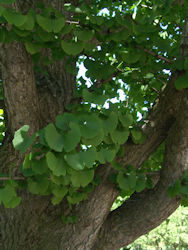
Photo by Karen Bergeron Copyright 2006


Habitat
 Perennial deciduous tree, native to eastern China. Ginkgo Biloba is the oldest species of tree still living on the earth and can be traced back more than 300 million years. For this reason, ginkgo is often referred to as "the living fossil." A species of the family Ginkgoaceae, it is the only one of the family known to have survived the Ice Age. Cultivate with care, grow in gallon pots for a year or two before transplanting seedlings to their permanent location in the garden or landscape. Plant one for your Great, Great, Great, etc. grandchildren. They grow as tall as 70 feet and live (some say) a thousand years. When male and female trees are grown together, the female produces yellow plum-like fruits in autumn which when ripe look (strangely) like little brains! When these fall to the ground and are squashed they give off a truly disgusting odor (like rancid butter) but contained within the fruit is a seed which is considered a delicacy in China where it is usually roasted before being eaten. The leaves are green to gold, fan-shaped, petioled, with many radiating veins and about 4 to 5 inches wide. Gather fresh green leaves in summer, dry for later use.


Properties
 Extracts of the fruit and leaves of the Ginkgo tree have been used in China for over 5,000 years. Ginkgo Biloba has been historically used in alternative medicine for Heart disease, Kidney disorders, Alzheimer's, Asthma and as an energy builder. Recently western researchers have been studying ginkgo biloba as a treatment for senility, hardening of the arteries, and as a treatment for oxygen deprivation. In over 34 human studies on Ginkgo it increases the body's production of the universal energy molecule adenosine triphosphate, commonly called ATP. This activity has been shown to boost the brains energy metabolism of glucose and increase electrical activity. Scientists also discovered that ginkgo contains an abundance of useful compounds including the antioxidants Vitamin C and carotenoids, but it is the flavanoid compounds collectively known as "ginkgolides" that are the most remarkable. The ginkgo flavonoids act specifically to dilate the smallest segment of the circulatory system, the micro-capillaries, which has a widespread affect on the organs, especially the brain. Researchers have also reported that Ginkgo extracts effectively increase blood circulation and increase oxygen levels in brain tissues. Ginkgo is also a powerful antioxidant that prevents platelet aggregation inside arterial walls, keeping them flexible and decreasing the formation of arteriosclerositic plaque. It has also been shown to help restore circulation to areas of the brain damaged by stroke. Ginkgo has a positive effect in Dementia cases, fighting free radicals in the blood system, protecting against chromosomal damage (proven with Chernobyl workers). Ischemia-induced spinal cord injury protection, heart muscle ischemia and reper-fusion injury protection. Protection against retinal damage, helping with tinnitus, headaches, vertigo, hearing loss, depression, allergies, atherosclerosis, cardiac arrhythmia, diabetic peripheral disease, eczema, glaucoma, impotency, retinitis, to treat asthma, to aid digestion, and bring back sexual energy as well as treating early stages of Alzheimer's disease. The brain is one of the most metabolically active tissues in the human body. It uses a great deal of energy which requires a steady supply of oxygen and glucose. Unlike most other tissues, the brain has very little energy reserve which makes it extremely susceptible to the effects of poor blood supply. When circulation is inadequate, the brain cannot function at its full capacity. The big news for ginkgo came in October 1997 when the Journal of the American Medical Association published the results of a study that confirmed that ginkgo had a positive effect in cases of dementia. They used only patients whose main problem was mental impairment, whether someone had termed it Alzheimer’s or not. They used every control imaginable and rated progress on three different scales to make sure that their results were accurate. Researchers even went so far as to switch everyone from the placebo to the real medicine and vice versa in the middle of the study. There is no doubt about it. Ginkgo stopped the progress of the disease in most cases, and many cases reversed the damage. A Swedish study showed that ginkgo improved the distance-vision of people who already showed signs of degeneration in the retina. The disease macular degeneration, a leading cause of blindness, is strongly related to hemorrhages in the fine blood vessels in the eye, possibly due to oxidative stress. By strengthening the tiny blood vessels in the eye, and by acting as an antioxidant, ginkgo provides a double whammy against eye diseases. It eliminates waste material and inhibits the clumping of blood platelets and prevents circulating platelets from sticking together, which contributes to heart problems, strokes and artery conditions. Ginkgo is an adaptogen herb, which helps the body with stressful situations. It is also helpful in the treatment of allergies, Alzheimer's disease, anxiety attacks, arthritis, ADD, circulatory disorders, cancer, coughs, depression, dizziness, equilibrium problems, headaches, heart & lung problems, memory loss, mood swings, muscular degeneration, tinnitus, toxic shock syndrome, varicose veins, vascular impotence & vertigo. Studies have shown that the length of time a person uses this plant leaf is very important. With ginkgo, the effectiveness may not be felt for twelve weeks. While most people note some improvement in just two to three weeks, others take longer to respond. Ginkgo biloba extracts are relatively considered safe and free of side effects, though taking very large doses may lead to diarrhea, nausea and vomiting, which can be controlled by reducing the amount consumed. Those taking blood thinners should consult with their physician before taking ginkgo biloba in high doses, due to their blood thinning tendencies. It is also advisable to discontinue use prior to surgery.

Folklore
 
Ginkgo is strong in legend and lore of China, and has been lovingly adopted by most cultures in the temperate regions of earth. Darwin called it a living fossil, the only species remaining of a genus which flourished in the time of the dinosaurs. Gingko is held or carried to help improve the memory. A mild tea prior to bedtime will help to remember dreams during sleep.

Article by Deb Jackson       

Next > Ginseng


Alternative Nature Online Herbal
Copyright © 1997 - 2011. All Rights Reserved by Alternative Nature Enterprises.
Editor Karen Bergeron
AltNature Herbals  P.O. Box 93 Erin, TN 37061
Please use email for questions about herbs.  Email karen@altnature.com

Medicinal Herb Uses, Pictures and Descriptions    Browse 500+ Herb Pictures  Herb Farming  |  Herb and Alternative Medicine ArticlesGinseng Information  | Poison Ivy Pictures Herbal Links
 Contact | Privacy Policy | Store | Advertising | Blog  | Facebook Page


 The herbal information on this web site is intended for educational purposes only. It is not the intention of the editor to advise on health care. Please see a medical professional about any health concerns you have.  Disclaimer - These statements have not been evaluated by the FDA.  The information on this web site is not intended to prevent, diagnose, treat, or cure any disease.

This information is intended as an introduction to how medicinal herb plants are used. It is intended for educational purposes only. I am not a medical professional and I cannot prescribe what herbs are right for you. I cannot answer medical questions, so please do not ask me (or any other complete stranger for that matter) to prescribe herbal cures, treatment or to guess what is wrong with you.

If you use herbs, do so responsibly. Consult your doctor about your health conditions and use of herbal supplements. Herbs may be harmful if taken for the wrong conditions, used in excessive amounts, combined with prescription drugs or alcohol, or used by persons who don't know what they are doing. Just because an herbal remedy is natural, does not mean it is safe! There are herbs that are poisonous such as Poison Hemlock, Jimson weed, and many more.

I will be happy to help you ID wild plants that you find, or help you locate herbs, plants or herb seeds and especially pictures.
email
karen@altnature.com

Amazing Jewelweed Remedies
Herbal Remedy for Poison Ivy, Oak and other skin condition