Heal All Herb
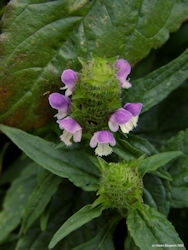 Prunella vulgaris
Other Names: Prunella, All-Heal, Hook-Heal, Self Heal, Slough-Heal, Brunella, Heart of the Earth, Blue Curls, Carpenter-weed, Common Self-heal, Consolida Minor, Lance Self-heal, Sicklewort, Woundwort, Xia Ku Cao
Prunella Vulgaris picture by Karen Bergeron (c) 2006
Prunella Vulgaris Herb Uses
Prunella Vulgaris is edible and used as a herb. It can be used in salads, soups, stews, or boiled as a pot herb. Heal All has been used as an alternative medicine for centuries on just about every continent in the world, and for just about every ailment known to man, Heal-All is something of a panacea, it does seem to have some herbal uses that are constant.
Recent research shows that application of Prunella Vulgaris is helpful in controlling herpes outbreaks in mice, click here to read more.
List of Links to Prunella Vulgaris Clinical Studies
Prunella’s most useful constituents are Betulinic-acid, D-Camphor, Delphinidin, Hyperoside, Manganese, Oleanolic-acid, Rosmarinic-acid, Rutin, Ursolic-acid, and Tannins. The whole plant is said to be alterative, antibacterial, antipyretic, antiseptic, antispasmodic, astringent, carminative, diuretic, febrifuge, hypotensive, stomachic, styptic, tonic, vermifuge and vulnerary.
A cold water infusion of the freshly chopped or dried and powdered leaves is a very tasty and refreshing beverage, weak infusion of the plant is used as an eye wash for sties and pinkeye. Prunella is taken internally as a herbal tea in the treatment of fevers, diarrhea, sore mouth and throat, internal bleeding, and weaknesses of the liver and heart. Clinical analysis shows it to have an antibacterial action, inhibiting the growth of pseudomonas, Bacillus typhi, E. coli, Mycobacterium tuberculi, which supports its use as an alternative medicine internally and externally as an antibiotic and for hard to heal wounds and diseases. It is showing promise in research for herpes, cancer, AIDS, diabetes, and many other maladies.
Prunella : Herbal Remedy May Help Combat Endometriosis and Cancer
Prunella Vulgaris is one of the latest herbs making headlines as a natural treatment for herpes. Next to Jewelweed and possibly Ginseng, this is the herb I am most asked about lately.
Prunella Vulgaris Salve and Liquid Wash
Prunella, Natural Herpes Cure?
Buy Heal All Seeds at Seedman.com
A Short Video of Heal All I think I made it in 2006.
There are no known safety issues or contraindications for using the herb Prunella Vulgaris.
Prunella Vulgaris Description and Habitat
Prunella Vulgaris is a perennial herb found throughout Europe, Asia, Japan and the U. S., (to mention a few) its origin seems to be European though it has been documented in other countries since before any history of travel. Prunella Vulgaris is found growing in waste ground, grassland, woodland edges, usually on basic and neutral soils. It seems to grow just about everywhere. Prunella grows from 1 to 2 feet high, with creeping, self-rooting, tough, square, reddish stems branching at leaf axis. Once the plant reaches any significant height, it falls over and attaches new roots to the ground if possible, much like skullcap and other herbs in the mint family. The leaves of Prunella Vulgaris are lance shaped, serrated and reddish at tip, about an 2 -3 inches long and 1 inch broad, grow on short stalks in opposite pairs down the square stem. The flowers grow from a club-like, somewhat square, whirled cluster, immediately below this club are a pair of stalkless leaves standing out on either side like a collar. Prunella flowers are two lipped and tubular, the top lip is a purple hood, and the bottom lip is often white, it has three lobes with the middle lobe being larger and fringed upwardly. Prunella Vulgaris flowers bloom at different times depending on climate and other conditions. Mostly from June to August.
Unsponsored External Links - Is Heal All Native or Exotic to the US? It's Both!
Herbal Study Group Printout from Luna Herb
How to Grow Prunella Vulgaris
Prunella Vulgaris thrives in any damp soil in full sun or in light shade. It will grow thicker in a part shade environment. Prunella Vulgaris is a good plant for growing in the spring meadow. Sow seed in very early spring in a flat outdoors, or give a short cold and moist conditioning treatment before sowing in a warm place. As Prunella Vulgaris is related to the mint family, it transplants and spreads easily. Some not so enlightened people might consider it a weed.
Click here to buy Organic Prunella Vulgaris Herb Seed
Harvesting and Using Prunella Vulgaris
Gather flowering tops, and dry in small bunches for later herb use, or tincture fresh. Store in cool, dry, dark, place for best shelf life.
Prunella Vulgaris Folklore and History
Prunella Vulgaris was once proclaimed to be a Holy herb and thought to be sent by God to cure all ailments of man or beast, and said to drive away the devil, which lead to the belief that Heal-All was grown in the Witches garden as a disguise. The root was used to make a tea to drink in ceremonies before going hunting by one Native American tribe to sharpened the powers of observation.
Prunella Herbal Tea Recipe
Herbal tea or infusion: Add 1 oz. dried or fresh herb to a pint of boiling water, steep till cool, take in cup doses, sweetened with honey, as a general immune strengthener.
Article by Deb Jackson & Karen Bergeron
References
USDA Plants Database Prunella Vulgaris Info
Prunella Vulgaris by Ray Sahelian, M.D.
Copyright Karen Bergeron 2006 - 2016. Do not use without permission.
Disclaimer
The herbal information on this web site is intended for educational purposes only. It is not the intention of the editor to advise on health care. Please see a medical professional about any health concerns you have. These statements have not been evaluated by the FDA. The information on this web site is not intended to prevent, diagnose, treat, or cure any disease.