Red Clover
Karen Bergeron, Deborah Jackson Copyright 2000 Updated 02/18/2019
Trifolium pratense
Other Names: Meadow Honeysuckle, Meadow Trefoil, Purple Clover, Trefoil, Wild Clover, Cleaver Grass, Marl Grass, Cow Grass
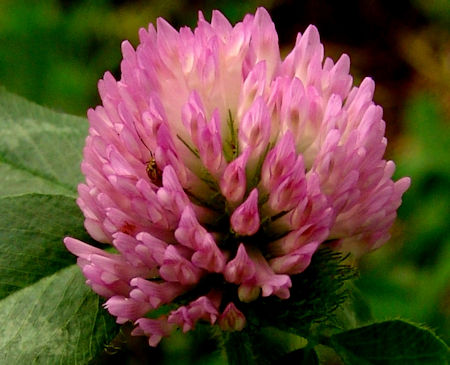
Photo by Karen Bergeron Copyright 2010
Red Clover Herbal Uses
Red Clover is edible, the young leaves and new flowers are harvested, and are used in salads, soups, or as a pot herb. The sprouted seeds are edible in salads and have a crisp texture and robust flavor. A delicate, sweet herbal tea is made from the fresh or dried flowers,
The following information is based on historical uses found in herbal lore and unscientific claims. There is insufficient research on this herb to prove benefits or safety issues it may have in humans.
Red Clover has been used as an anticancer herb. Poultices of the herb have been used as local applications to cancerous growths. Internally, the Red Clover plant is used as an alternative remedy for skin complaints such as eczema and psoriasis, cancers of the breast, ovaries and lymphatic system, chronic degenerative diseases, gout, whooping cough and dry coughs.
Red Clover is said to be alterative, anti-scrofulous, antispasmodic, aperient, detergent, diuretic, expectorant, sedative and tonic.
Red Clover Habitat and Description
Red Clover is a perennial herb, origin believed to be Britain where it is abundant, now a world wide escape, naturalized in nearly every country, even the Arctic Circle and high up into mountains. The long root is rhizome, and sends out runners, producing several stems 1 to 2 feet high, slightly hairy; leaves ternate, leaflets ovate, slightly toothed, ending in long point often lighter colored V shape in center, flowers red to purple, fragrant, in dense terminal ovoid or round heads.
Harvest flowers and dry for later herb use as it comes into bloom. Harvest edible leaves for salad before flowers fully bloom.
How to Grow Red Clover
Red Clover is an easily grown plant, from seed or root cuttings, requires little attention.
Red Clover History and Folklore
In the middle ages the clover was considered a charm warn to ward off evil spirits and witches. The four leaf clover was said to have even more power against evil, a five leaf clover was said to be warn by witches to give them evil powers, and a two leaf clover would give a maiden the power to see her future lover.
Red Clover Herbal Recipe
Herbal tea: To 1 tbs. dry flowers or herb add 1 cup boiling water, steep 10 min., sweeten to taste, drink warm for cough and upset stomach.
Disclaimer
The herbal information on this web site is intended for educational purposes only. It is not the intention of the editor to advise on health care. Please see a medical professional about any health concerns you have. These statements have not been evaluated by the FDA. The information on this web site is not intended to prevent, diagnose, treat, or cure any disease.