Solomon's Seal
Polygonatum biflorum
Other Names: American Solomon’s Seal, King Solomon’s Seal, Lady’s Seals. St. Mary’s Seal.
Solomon Seal Herb Use
Solomon Seal has a long history of use in alternative medicine dating back to the time of Dioscorides and Pliny. The main constituents are saponins (similar to diosgenin), flavonoids, and vitamins. A infusion of root or rhizome, is used in alternative medicine as an astringent, demulcent, and tonic. The dried herb is taken as a laxative and restorative, and is good in inflammations of the stomach, indigestion, profuse menstruation, lung ailments, general debility, bowels, piles, and chronic dysentery. A herball poultice of the fresh roots is said to fade bruises, also applied to cuts and sores.
Edible Use
Solomon’s Seal is edible. The young edible shoots are an excellent vegetable when boiled and eaten like Asparagus. The root is edible after boiling in three changes of water or sun baked, and is a good source of starch.
Solomon Seal Habitat and Description
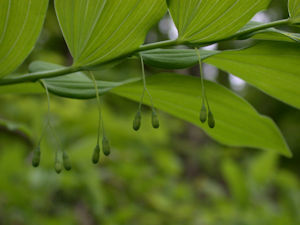
Solomon Seal is a perennial native herb found growing in moist sandy, loamy or rocky woods and thickets, in North America from New Brunswick to Michigan, and south to Tennessee and Florida. The creeping root, rhizome, or underground stem, is thick and white, twisted and full of knots, with large circular scars at intervals These scars give Solomon’s Seal its name. Stems grow to a height of from 18 inches to 2 feet, or even more and bend over gracefully. Large, light green, and broad ovate leaves grow alternately on the stem, clasping it at the bases. The flowers are tubular, succulent and thick, light yellow- green, and hang in little drooping clusters of two to five, growing from the leaf axils. Flowers bloom April to June. The fruit is a small berry about the size of a pea, blackish-blue, fruit is not edible, said to be poisonous. Gather roots in fall as flows fade, dry for later herb use.
Cultivation: a very hardy plant, it prefers a light soil and a shady situation. Seeds, or transplants, if taken up with plenty of soil.
Folklore Once believed to have aphrodisiac properties, and used in love potions. More than likely due to its ability to stop profuse menstruation. Gerard says: ’The roots of Solomon’s Seal, stamped while it is fresh and green and applied, taketh away in one night or two at the most, any bruise, black or blew spots gotten by falls or women’s willfulness in stumbling upon their hasty husband’s fists, or such like.’
Herbal tea: To 1 tsp. dried herb add 1 cup boiling water, steep for 10 min. sweeten to taste, take in the morning as laxative.
Article by Deb Jackson & Karen Bergeron