Trilliums, Birthroot, Beth Root
Prairie Trillium (Trillium recurvatum) White Trillium (Trillium Grandiflorum) Toad Shade (Sessile Trillium)
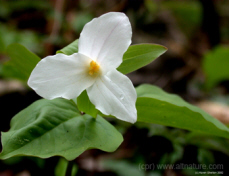
Do not harvest Trilliums from the wild.
The Flower No One Should Pick (External Link)
Many types of Trilliums appear throughout our area in early spring. The flower symbolizes the early arrival of robins.: Wake-robin’ is a common name for Trilliums. Trillium is a very ornamental and long-living plant. It is said to be a polymorphic species and is very subject to mutation.
Trilliums are perennials native to Eastern N. America and Canada, Maine to Ontario, south to Georgia and Arkansas. They are found growing in rich woods and thickets. Trillium grows from a short thick root or rhizome. Flowers bloom from Marchl to June. The flower perches above the leaves on a 2 to 3 inch petiole or small stem, or is sometimes sessile (having no stem) as with the Toad shade Trillium or the Prairie Trillium, and may be dark red to pink or white or even both, but always with 3 petals and 3 green sepals, forming a star shape. The long stem is tinged with red, round and smooth, unbranched, growing up to 2 feet high. Atop the stem there is a whorl of 3 broadly ovate, short petiole, wavy-edged and dark green (sometimes mottled) leaves. This whorl of leaves can reach as much as 10 to 12 inches in diameter .
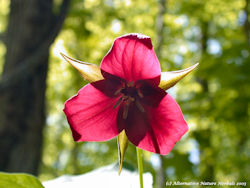
How to grow Trilliums
Trilliums prefer a deep well-drained woodland or humus-rich soil in a shady position that remains moist in the summer. Trilliums can be propagated by seed though it may take 2 years to germinate and another two years to bloom. Bulbs can often be purchased from garden centers and seed catalogs for easy growing. Many species of Trilliums are protected or endangered and should not be harvested or transplanted from the wild.
According to ginsengers, this group of flowers, as well as Jack in the Pulpit; are good indicators of soil favorable for growing wild ginseng.
Trillium Herbal and Edible Use
Trillium is edible and and has been used in herbalism throughout North America for centuries. It has a long history of use by Native Americans. The young edible unfolding leaves are an excellent addition to salad tasting somewhat like sunflower seeds.The leaves can also be cooked as a pot herb but there are plenty of other more abundant greens this time of year.
Trillum root is used as an alternative medicine and may have antiseptic, antispasmodic, diuretic, emmenagogue (to promote menstruation), and ophthalmic properties.. The roots, fresh or dry, have been boiled in milk and used for diarrhea and dysentery. (Use cinquefoil, speedwell or agrimony instead) The raw root is grated and applied as a poultice to the eye in order to reduce swelling, or on aching rheumatic joints. The leaves were boiled in lard and applied to ulcers as a poultice, and to prevent gangrene. ( Use chickweed or plantain instead.) An infusion of the root is used in the treatment of cramps and a common name for the plant, birthroot’, originated from its use to promote menstruation. (Try Black Haw or Crampbark instead.) A decoction of the root bark can be used as drops in treating earache. (Use Mullein flowers instead.)
Constituents found in the volatile and fixed oils are, tannic acid, saponin, a glucoside resembling convallamarin, sulphuric acid and potassium dichromate, gum, resin, and starch.
Trillium Folklore and History
Trillium root was used to facilitate childbirth, and to treat other female problems by the women of many Native American tribes. Trillium root was considered to be a sacred female herb and they only spoke of it to their medicine women.
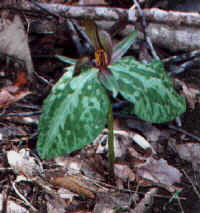
Toad Shade Trillium
Disclaimer
The herbal information on this web site is intended for educational purposes only. It is not the intention of the editor to advise on health care. Please see a medical professional about any health concerns you have. These statements have not been evaluated by the FDA. The information on this web site is not intended to prevent, diagnose, treat, or cure any disease.