Trout Lily
Erythronium americanum
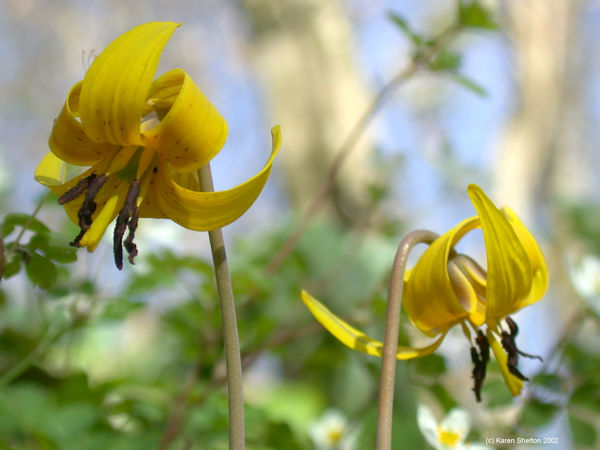
Other Names: Adder’s tongue, American trout-lily, Dog’s tooth violet, Serpent’s Tongue, Yellow Adder’s-tongue, Yellow fawn-lily, Yellow Snowdrop
Trout Lily Herbal and Edible Properties
Caution! Trout Lily can be strongly emetic in some people (which means it makes you throw up a lot).
Edible and used as an herb, the whole Trout Lily plant is used as fresh salad additives, flowers are tasty, or cooked as a pot herb.
Recipe: Salad addition: Use 1 tbls. per person, fresh flower petals, chopped root, and leaves in a tossed salad.
Trout Lily is used in alternative medicine as contraceptive, diuretic, emetic, emollient, febrifuge, stimulant. Plant constituents include alph-methylene-butyrolactone which has antimutagenic activity. This chemical prevents cell mutation and may prove to be a valuable weapon in fighting all cancers. The leaves and bulb are crushed and used to dress wounds and reduce swellings, (Use Chickweed, Ground ivy or Plantain instead) for scrofula and other skin problems. A herbal tea made from the root and leaf is said to reduce fever and fainting, tea also taken for ulcers, tumors and swollen glands. (Try Cleavers instead
Trout Lily Habitat and Description
Trout Lily is a North American native perennial found growing in damp, open woodlands from New Brunswick to Florida and west to Ontario and Arkansas. The root is a deeply buried, bulb-like corm, light brown, about 1 inch long, and solid with white starchy flesh. Two or three leaf blades grow from the base and are about 3 inches tall, oblong, smooth, dark green, with purplish mottling, and about 1 inch wide. The slender stem is 3 to 4 inches long and leafless. The flowers of Trout Lily can be bright white or creamy colored to bright yellow it is about 3 inches across, lily-like and drupes with the six petals folded upwards. Trout Lily blooms in April and May.
Cultivation: a member of the Lily family Trout Lily is cultivated by seed or transplanting of the bulb or corm in fall. Prefers slightly acid well-drained soil, plenty of humus and requires semi-shade.
The edible fresh leaves, bulbs and flowers were gathered in spring and root in summer to fall. The root was dried when dug in fall for medicinal use.
Trout Lily is not common enough for wildcrafting. There are many common plants that can be substituted for herbal remedies.
Trout Lily Folklore and History
It is said that the Cherokee Indians would chew Trout Lily root and spit it in the water to make fish bite. The young women of one tribe ate the raw plant in large quantities to prevent conception, probably due to the fact they were too busy vomiting!
Article by Deb Jackson & Karen Bergeron
Disclaimer
The herbal information on this web site is intended for educational purposes only. It is not the intention of the editor to advise on health care. Please see a medical professional about any health concerns you have. These statements have not been evaluated by the FDA. The information on this web site is not intended to prevent, diagnose, treat, or cure any disease.