May Special!
Jewelweed Soap by the Pound!

Be Prepared for Summer and Poison Ivy!
Learn more here!
Scored for easy cutting into 4 large bars
(As low as 13.55 a pound with coupons and two pound purchase)

Repeat customers, save even more!


WILDCAROTSM.JPG (21602 bytes)
Photo by Deb Jackson Copyright 2000


Wild Carrot
Daucus carota

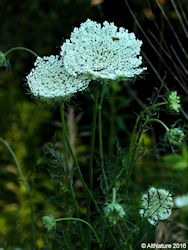
Queen Anne's Lace is the wild progenitor of our cultivated carrot. It still has many of the properties lost in cultivation. If an apple a day will keep the Doctor away a wild carrot a day might keep death itself away!

Other Names:  Queen-Anne's lace, Bees' Nest, Bird's Nest, Carrot, Carotte, Carrot, Wild Carrot, Yarkuki, Zanahoria Wild Carrot, Birds Nest Weed, Devils Plague, Garden Carrot, Bee's nest plant, Bird's nest root

Habitat
    Biennial herb originally a native of Southern Europe, it has become naturalized throughout the United States and Canada.

Cultivation
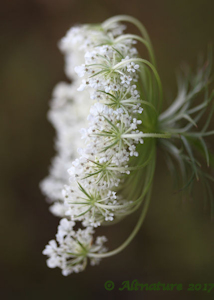
    Wild Carrot is easy to grow, it prefers a sunny position and a well-drained neutral to alkaline soil. Considered an obnoxious weed by some, it can spread very quickly. In its second year, from a taproot (the carrot) stems grows to a height of two to four feet or more, they are erect and branched, both stems and leaves are covered with short coarse hairs. The leaves are very finely divided-tri-pinnate, alternate, and embrace the stem with a sheathing base. The two to four inch "flower" is actually a compound of terminal umbels, made up of many small white flowers. The central flower of the Umbelliferae is often purple. A ring of finely-divided and leaf-like bracts grows at the point where the umbel meets the stem. Blooming from June to August, but often continues to bloom flowers much longer. Its root is small and spindle shaped, whitish, slender and hard, (tender when young), but soon gets tough, with a strong aromatic smell. Harvest entire plant in July or when flowers bloom, and dry for later herb use. Collect edible roots and shoots in spring when tender. Gather seed in fall.

Properties
   Wild Carrot is edible and medicinal, root is edible cooked or raw, flower clusters can be french-fried for a carrot-flavored, quite attractive dish. The aromatic seed is used as a flavoring in stews and soups. Used for centuries as an alternative medicine. 

    This long list of chemical constituents and their activities, contained in Wild Carrot is brought to you courtesy of Dr. James A. Duke and his wonderful website. Acetone, acetyl-choline, alpha-linolenic-acid, alpha-pinene, alpha-tocopherol, apigenin, arachidonic-acid, arginine, asarone, ascorbic-acid, bergapten, beta-carotene, beta-sitosterol, caffeic-acid, camphor, chlorogenic-acid, chlorophyll, chrysin, citral, citric-acid, coumarin, elemicin, esculetin, ethanol, eugenol, falcarinol, ferulic-acid, folacin, formic-acid, fructose, gamma-linolenic-acid, geraniol, glutamine, glycine, hcn, histidine, kaempferol, lecithin, limonene, linoleic-acid, lithium, lupeol, lutein, luteolin, lycopene, magnesium, manganese, methionine, mufa, myrcene, myricetin, myristicin, niacin, oleic-acid, pantothenic-acid, pectin, phenylalanine, potassium, psoralen, quercetin, scopoletin, stigmasterol, sucrose, terpinen-4-ol, thiamin, tryptophan, tyrosine, umbelliferone, xanthotoxin, and a slew of other Vitamins and minerals. These constituents are known to have these activities, Analgesic, Anti-arthritic, Antidepressant, Anti-psychotic, Anti-schizophrenic, Antidote, Anti-inflammatory, Antibacterial, Anticonvulsant, Anti-diabetic, Anti-estrogenic, Anti-flu, Antihistaminic, Antioxidant, Antiseptic, Antispasmodic, Anti-epileptic, Anti-anxiety, Anti-stress, Ant-PMS, Anti-hangover, Antiviral, Cancer-Preventive, Expectorant, Fungistat, Immunostimulant, MAO-Inhibitor, Sedative, Tranquilizer, Aphrodisiac, Sweetener, Pituitary-Stimulant, and more. Ongoing studies are proving this to be a very valuable plant, useful in many areas of alternative medicine, a few are Alzheimer's, Crohn's disease, Parkinson's disease, Infertility, Asthma-preventive, most types of cancer, Diabetes, Leukemia, HIV, Spina-bifida, Migraine headache, obesity, and much more, even the common cold. Used as a medicinal herb for thousands of years as an anthelmintic, carminative, contraceptive, deobstruent, diuretic, emmenagogue, galactogogue, ophthalmic, and stimulant. 
    A medicinal infusion is used in the treatment of various complaints including digestive disorders, (soothes the digestive tract), kidney and bladder diseases and in the treatment of dropsy, it supports the liver, stimulates the flow of urine and the removal of waste by the kidneys. A wonderfully cleansing medicinal herb, an infusion of the leaves has been used to counter cystitis and kidney stone formation, and to diminish stones that have already formed. The seeds can be used as a settling carminative agent for the relief of flatulence and colic. 

    Wild Carrot leaves contain significant amounts of porphyrins, which stimulate the pituitary gland and lead to the release of increased levels of sex hormones, and stimulates the uterus. The plant is also used to encourage delayed menstruation, can induce uterine contractions and so should not be used by pregnant women. The seed is a traditional 'morning after' contraceptive and there is some evidence to uphold this belief. An essential oil obtained from the seed has also been used cosmetically in anti-wrinkle creams. A strong decoction of the seeds and root make a very good insecticide.

Folklore
   The name 'Carrot' is Celtic, and means 'red of color,' and Daucus from the Greek dais to burn, signifying its pungent and stimulating qualities. An Old English superstition is that the small purple flower in the center of the Wild Carrot was of benefit in curing epilepsy.

Recipe

"Medicinal" tea: To 1 OZ. of dried herb add 1 pint of boiling water steep l0-l5 min. drink three times a day.

Article by Deb Jackson & Karen Bergeron

Next > Wild Geranium

 Alternative Nature Online Herbal
Educating about Medicinal Herbs Online Since 1997

EMAIL

Medicinal Herbs List

High Resolution Herb Stock Photos click here  

Free Herb Pictures for web sites,
click here

Natural Poison Ivy Treatment

 Prunella Vulgaris
The Herb for Herpes.

Alternative Medicine and Herb Articles 

Add Alternative Nature Online Herbal to your Favorites

Vote for Health Freedom,
Click here!

Ron Paul 2008

Medicinal Herb Plant Pictures and Descriptions List

Agrimony
Cocklebur
Aletris Farinosa
True Unicorn Root
American Mandrake
May Apple
Angelica Bee Balm
Monarda, Bergamot
Birth Root,
Trilliums
Blackberry
Black Cohosh Black Walnut Bloodroot Blue Cohosh Blue Lobelia
Indian Tobacco
Blue Vervain Burdock New!
Butterfly Weed Pleurisy Root California Poppy Catnip Chickweed Cinquefoil
Five-finger-grass
Cleavers Dandelion
Downy Wood Mint Ephedra
American Ma-Huang
Evening  Primrose Everlasting
Rabbit Tobacco
Feverfew German Chamomile Ginkgo Biloba 
Ginseng Goat's Rue Goldenseal Greek Valerian  Jacob's Ladder Ground-Ivy Heal-All , Prunella
All-Heal, Self heal 
Hepatica, Liverwort
Jack-in-the-Pulpit
Indian Turnip
Passionflower Maypop,
Apricot Vine
Jewelweed
Touch-me-nots
Joe Pye Weed Gravel Root Lemon Balm Melissa, Balm Lyre-leaved sage Mallows
May Apple Mugwort Mullein Perilla
 Beefsteak plant
Pinkroot
Indian Pink
Plantain Pokeweed
Prunella Vulgaris Red Clover Sassafras Skullcap Soapwort Solomon's Seal Spearmint
St. John's Wort Trout Lily Usnea Violet Violet Wood Sorrel Watercress Wild Carrot
Queen-Anne's lace
Wild Geranium Cranesbill Wild Ginger Wild Mint
Mountain Mint
Wild Quinine
Missouri snakeroot
Wild Rose, Hips Wild Yam Wood Betony Lousewort
Yarrow Milfoil            

Click here to buy Organic Medicinal Herb Seed 

Important Wildcrafting Links ( Off Site, Non-commercial information )
 Wildcrafting for the Practical Herbalist  Manual PDF     Herb Hunters Guide   Wildcrafting Checklist


Plants for a Future - a resource centre for rare and unusual plants, particularly those which have edible, medicinal or other uses

Alternative Medicine and Herb Articles  

Altnature Herbal Home  Medicinal Herbs Uses and Pictures Gallery   Jewelweed, Herbal Poison Ivy Treatment 
 Herbal Links 
 Poison Ivy Pictures Gallery  Herb Farming Info  Altnature Store 
View Free Herbal Videos   Herbal Photography
 
Herbal Q & A's 
 Prunella Vulgaris   Add to Favorites   Altnature Privacy / Confidentiality Policy 

Alternative Nature Online Herbal   Educating about Medicinal Herbs Online since 1997
Karen Bergeron Owner, Editor Alternative Nature Herbals PO Box 93 Erin TN 37061
 
Email kbergeron@altnature.com

Copyright © 1997 - 2007. All Rights Reserved by Alternative Nature.

Disclaimer: This herbal web site was designed to teach about herbs, wild herb conservation, historical uses and latest herb research. This information is presented for educational use only. It is not meant to diagnose, cure, treat or prevent any disease. Please discuss your health issues as well as herb and supplement use with your doctor.

  Free Herb Pictures for Your Web Site
From my own collection

Subscribe to AltnatureHerbNews
Powered by 
health.groups.yahoo.com
More Alternative Health Articles at  www.alternative-herbal-medicine.net

Nature's Herbal Natural Mosquito & Insect Spray w/Catnip Oil

Amazing Jewelweed Remedies
Herbal Remedy for Poison Ivy, Oak and other skin conditions

The FDA mandates the following disclaimer for all herbal remedies and information.
According to them, only drugs - not traditional natural remedies or herbs- can heal you.
You should discuss your health options with your doctor.

Disclaimer - These statements have not been evaluated by the FDA.
 The information on this web site is not intended to diagnose, treat, or cure any disease.