Wood Betony, Lousewort
Pedicularis canadensis
Other Names: Betony, Canadian Lousewort, Common Lousewort, Lousewort, Wood Betony
Lousewort Edible and Herbal use
Wood Betony, or Lousewort is an edible plant and also used as an herb. It was much used by Native Americans and prized for its herbal and aphrodisiac qualities. The leaves and stems are cooked as pot herb.
The active constituents in the plant are betaine, betulinic-acid, caffeic-acid, chlorogenic-acid, harpagide, rosmarinic-acid, and tannin. As an alternative medicine it is an emmenagogue , anodyne, anti-tumor, aphrodisiac, blood tonic, cardiac, poultice, stomachic.
A herbal infusion of the roots is used as blood tonic, cardiac for anemia and heart troubles and to treat stomach aches, ulcers, and bloody diarrhea. A poultice of the crushed root is applied to swellings, sore muscles, varicose veins, and tumors. The roots are finely grated and added to food as an aphrodisiac. An infusion of the fresh leaves or dried herb has been used to treat a sore throat, tonsillitis, cough and bronchitis. Infusion also used to treat headaches, dizziness, urinary, bladder and kidney pain. Wash or dip in a strong decoction is used to rid animals and people of lice and scabies.
Lousewort Habitat and Description
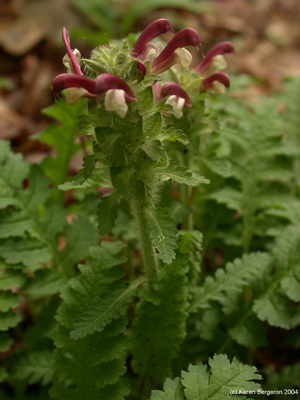
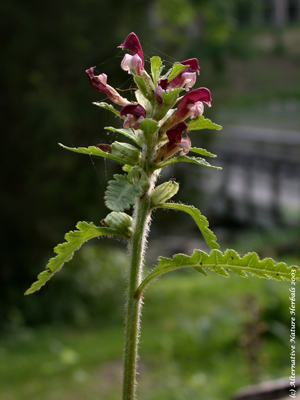
Perennial herb, native to Eastern North America from Nova Scotia to Manitoba, south to northern Mexico and east to Florida. Growing in moist open woods, thickets, along roadsides and clearings. Cultivation: Wood Betony is a member of the figwort family (Scrophulariaceae), difficult to cultivate, some reports say that it is a semi- parisic plant. It requires a moist well-drained soil and a partially shaded to sunny area. A low growing hairy plant 5 to 14 inches tall with up to five erect unbranched stems in a clump. A broad whorl of tubular, hooded flowers tops each stem, 10-20 flowers form a cluster. Flowers are about an inch long, may be pale yellow, yellow, red, or even a mixture of the two. Leaves are soft and hairy, alternate, mostly basal, and from 3 to 5 inches long. Leaf blades are fern-like and pinnately dissected, often tinted red. Upper leaves are about an inch long. Gather entire plant, as flowers bloom, dry for later herb use.
Lousewort History and Folklore
An Indian Love Medicine, the root was carried by a person who was contemplating making love advances. One tribe chopped the root and added it to feed to make a pony fat and vicious to all but its owner. Early Europeans believed that cattle, feeding on lousewort, became covered with lice.
Lousewort Recipe
Herbal tea: To 1 cup water add 1 tbls. dried herb, bring to boil, steep 10 min. strain, sweeten to taste, drink warm at bed time.Article by Deb Jackson & Karen Bergeron
Disclaimer
The herbal information on this web site is intended for educational purposes only. It is not the intention of the editor to advise on health care. Please see a medical professional about any health concerns you have. These statements have not been evaluated by the FDA. The information on this web site is not intended to prevent, diagnose, treat, or cure any disease.