Angelica Herb Uses
Angelica archangelica
Angelica archangelica, Angelica Venenosa
Other Names: Alexanders, American Dong Qui, Archangel, Purple-stem Angelica, American Angelica, High Angelica, Wild Archangel, Wild Angelica, Masterwort
Angelica Herb Uses
Angelica is used extensively in herbal medicine. Angelica is a very good tonic herb for women and children, the elderly or general debility and it is said to strengthen the heart. Powdered Angelica root is said to cause disgust for liquor. It has an antibacterial action, preventing the growth of various bacteria. Angelica is used for obstructed menses and should not be taken in large quantities by pregnant women.
Angelica infusion is used externally as a gargle for sore throats and mouths and as a poultice for broken bones, swellings, itching and rheumatism and when used as a wash for the face, is said to prevent acne. A powder made from the dried root is used for athlete's foot, as well as an insecticide and pesticide.
NOTE The fresh root of Angelica is not edible, said to be poisonous. Do not use while pregnant or breastfeeding without consulting your doctor.
Angelica root contains vitamin B12, Zinc, Thiamine, Sucrose, Riboflavin, Potassium, Magnesium, Iron, Fructose, Glucose, and many other trace minerals.A infusion made from Angelica stems, seeds, and root is carminative, diaphoretic, emmenagogue, sedative, stomachic and tonic . The main constituents of Angelica are volatile oils, valeric acid, angelic acid, angelicin, safrole, scopoletin, and linoleic acid, making it useful in the treatment of fevers, colds, coughs, flatulent colic and other stomach disorders.
Caution Click here to read cautions from Drugs.com
Angelica Native Habitat and Plant Description
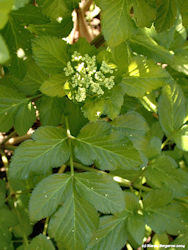
Angelica is a tall, stout very ornamental and aromatic plant with large white flowers, growing to a height of 4 to 6 feet or more. It is a biennial or short lived perennial herb native to Eastern N. America from Newfoundland to Ontario and Minnesota, south to Delaware, Illinois, Iowa and Tennessee. It is found in rich thickets, bottom-lands, moist cool woodlands, stream banks and shady roadsides. It has a smooth, dark purple, hollow stem 1 to 2 inches round. The leaves are dark green, divided into three parts, each of which is again divided into three serrated leaflets, sometimes lobed. The lower leaves are larger sometimes 2 feet wide. Angelica leaves have flattened, inward curved, stalks with clasping bases or sheathing to form an elongated bowl which holds water. The root is branched, from 3 to 6 inches long, thick and fleshy with several small rootlets. Flowers are small and numerous, yellowish or greenish-white and grouped into large, compound umbels. The flowers bloom in July and are succeeded by pale yellow, oblong fruits, 1/6 to a 1/4 inch in length when ripe produced in somewhat rounds heads, which sometimes are 8 to 10 inches in diameter.
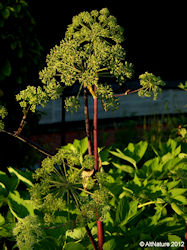
(c) Altnature 2006
How to Grow Angelica
Angelica is fairly easy to grow from seed. They are best planted as soon as they are gathered, but some will germinate if kept in freezer. Angelica requires a deep moist fertile soil in dappled shade, though I have seen Angelica Venenosa growing wild in full sun. Angelica will die after the second year if allowed to go to seed.
Angelica History and Folklore
According to one legend, (European-angelica) Angelica was revealed in a dream by an angel to cure the plague (hence the name Angelica or Archangel). All parts of the plant were believed effective against evil spirits and witchcraft. It was held in such esteem that it was called ’The Root of the Holy Ghost.’ In America it was used by the Iroquois and other tribes as Witchcraft Medicine, an infusion of smashed roots was used as wash to remove ghosts from the house.
Angelica Herb Recipes
The young shoots are edible in salad or boiled as a pot herb. It has a sweet taste similar to celery. Angelica stems are often preserved with sugar for a sweet edible treat. Candied Angelica Recipe
Harvest Angelica stems when young and tender. Root must be carefully dried and preserved for later herb use.
Angelica herb tea: To 1 tsp. dried Angelica root add 1 cup boiling water steep 15 to 20 min. take throughout the day and at bedtime.
Angelica Links
Angelica Herb Description and Uses
Article by Deb Jackson & Karen Bergeron Copyright 2000 - 2016 All rights reserved.
Disclaimer
The herbal information on this web site is intended for educational purposes only. It is not the intention of the editor to advise on health care. Please see a medical professional about any health concerns you have. These statements have not been evaluated by the FDA. The information on this web site is not intended to prevent, diagnose, treat, or cure any disease.