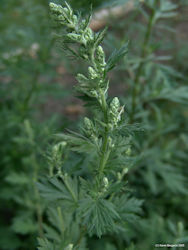
Mugwort
Artemisia vulgaris
Mugwort Herb Properties and Medicinal Uses
Other Names Artemisa, Carline Thistle, Chiu Ts’Ao, Common Mugwort, Douglas Mugwort, Felon herb, Sailor's tobacco, Wormwood
Mugwort has been used for centuries as an alternative medicine. It is antibacterial, anthelmintic, anti-inflammatory, antiseptic, antispasmodic, carminative, cholagogue, diaphoretic, digestive, diuretic, emmenagogue, expectorant, haemostatic, nervine, purgative, stimulant, stomachic, and tonic, cleansing toxins from the blood.
Extensive Article on Mugwort Use by my late friend Tephyr Burgess
An infusion of Mugwort leaves and flowering tops is used in the treatment of all matters connected to the digestive system, it increases stomach acid and bile production, eases gas and bloating, improving digestion, the absorption of nutrients and strengthening the entire digestive system. It is used in alternative medicine to expel intestinal worms, nervous and spasmodic affections, asthma, sterility, functional bleeding of the uterus and menstrual complaints, and diseases of the brain. As a gargle for sore throat, a wash for sores and a poultice for infections, tumors and to stop bleeding. These actions and uses are now backed by scientific studies on the plants main constituents volatile oils containing 1,8-cineole, artemisin, sesquiterpene lactones, flavonoids, coumarin derivatives, tannins, thujone and triterpenes. The leaves have an antibacterial action, inhibiting the growth of Staphococcus aureus, Bacillus typhi, B. dysenteriae, streptococci, E. coli, B. subtilis, and pseudomonas. A weak tea made from the infused plant is a good all-purpose insecticide. The fresh or the dried plant repels insects.
Caution: Mugwort Herb should not be used by pregnant women since it can cause a miscarriage.
Dr. Richard Alan Miller, Contributor
Dr. Richard Alan Miller has written works on
this subject, here are some of his comments
when I asked him about Mugwort. (Magical and
Ritual Use series - Inner
Traditions). "First, let me
say that the chemistries in question have
always been associated with the leaf-part of
the plant. Mugwort is a slightly
different species than Wormwood, but of the
same genus (and oils). Mugwort has an
irritant which limits the ability for deep
sleep. Hence, its use as a Dream
Pillow ingredient (allowing only low alphoid
activity). From a chemistry point-of-view,
there is very little difference in where this
crop is harvested. We farm more than 10
acres in CA, and that produced in WI is
essentially the same. It does like a
drier and hotter climate, but the herb grows in
almost every state. It is like Catnip,
with no real cultivar variations.This irritant,
when combined with other specific chemistries,
may also act as a light depressant. This
is especially true when combined with Passion
Flower and Lobelia. Tinctured, other
fatty oils become involved, making it a light
euphoric or aphrodisiac. For more detail,
see my titles Magical and RitualUse of Herbs
and Magical and Ritual Use of
Aphrodisiacs. --
Richard Alan
Miller DrRam@AOL.com DrRam@Magick.net
Mugwort Edible Uses
Mugwort leaves are edible, young leaves are boiled as a pot herb or used in salad, they aid in digestion although said to have a bitter taste.
Mugwort Habitat and Plant Description
Mugwort is a perennial herb native to Africa, temperate Asia, and Europe, widely naturalized in most parts of the world. Found growing on hedgebanks and waysides, uncultivated and waste land. Cultivation is fairly easy Mugwort prefers slightly alkaline, well-drained loamy soil, in a a sunny position. A tall-growing shrubby plant, with angular stems, which are and often purplish, growing 3 feet or more in height. The leaves are smooth and dark green above and covered with a cottony down beneath. They are alternate, pinnately lobed, and segmented. The small greenish yellow flowers are panicled spikes with a cottony appearance. Blooming is from July to October. Mugwort is closely related to Common Wormwood (Absinthe). Gather leaves and stems when in bloom, dry for later herb use.
Mugwort History and Folklore
In Native American folklore, Mugwort was also a Witchcraft medicine, rubbed the leaves on ones body to keep ghosts away or wearing a necklace to prevent dreaming of the dead. In the Middle Ages a crown made from its sprays was worn on St. John’s Eve to gain security from evil possession. Mugwort derived its common name from being used to flavor drinks like beer before the introduction of hops. The Name Artemisia is from the Goddess Artemis (1st century AD) who inspired the plants genus name.
Mugwort Recipe
Medicinal tea: Steep 1 tsp. dried herb in one cup boiling water, take in mouthful doses throughout the day.
Copyright Alternative Nature Herbal, 1999 -2017 All Rights Reserved
Article by Deb Jackson, Edited by Karen Bergeron
Disclaimer
The herbal information on this web site is intended for educational purposes only. It is not the intention of the editor to advise on health care. Please see a medical professional about any health concerns you have. These statements have not been evaluated by the FDA. The information on this web site is not intended to prevent, diagnose, treat, or cure any disease.