Pokeweed Herb
Phytolacca americana
Authors: Deb Jackson, Karen Bergeron Shelton (c)1998
Updated 2/07/2019 by Karen Bergeron
Other Names: Poke Salet, American Pokeweed, Cancer-root, Cancer jalap, Inkberry, Pigeon Berry, Pocan, Poke, Poke Root, Pokeberry, Reujin D Ours, Sekerciboyaci, Skoke, Virginian Poke, Yoshu-Yama-Gobo, Yyamilin
Caution : Toxic when misused. For experienced herbalists only. Can cause intense vomiting and diarrhea.
Poke weed Edible and Herbal Uses
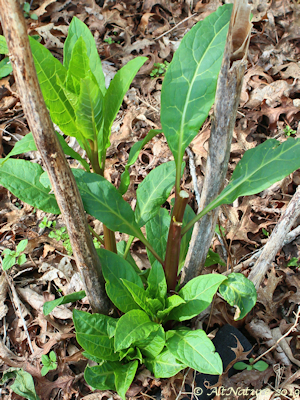
Pokeweed is edible when cooked properly, and also used as a medicinal herb. The young shoots are boiled in two changes of water and taste similar to asparagus and known as "Poke Salet" - not Poke Salad as it is commonly called. Poke berries are cooked and the resulting liquid used to color canned fruits and vegetables.
Caution is advised as the whole plant, but especially the berry, is poisonous raw, causing vomiting and diarrhea.
A beautiful red ink and a dye are obtained from the fruit. The rootstock is rich in saponins and can be used as a soap substitute.
According to Drugs.com , at doses of 1 g, dried pokeweed root is emetic and purgative. At lower doses of 60 to 100 mg/day, the root and berries have been used to treat rheumatism and for immune stimulation; however, there are no clinical trials that support these uses or doses.
Large doses of Poke weed can cause diarrhea and vomiting, as well as skin irritation. Pokeweed should never be used by pregnant women.
Pokeweed Properties and Constituents
Poke root is alterative, anodyne, antiinflammatory, cathartic, expectorant, hypnotic, narcotic and purgative. It is used in the treatment of rheumatoid arthritis, tonsillitis, mumps, glandular fever and other complaints involving swollen glands, chronic catarrh, bronchitis and diseases related to a compromised immune system it has potential as an anti-AIDS drug. Some of the chemical constituents in the plant are triterpenoid saponins, lectins, antiviral proteins and many phytolaccagenic acids, which are not completely understood.
Pokeweed Medical Research
The following is part of a repost from the now bankrupt Parker Hughes Cancer Institute: The two parts of this drug are the B43 antibody (or anti-CD19) and the pokeweed antiviral protein (PAP) immunotoxin, a natural product in the pokeweed plant. B43 is designed to recognize specific B-cell leukemia cells just as natural antibodies attack and recognize germs. When the antibody finds a leukemia cell, it attaches and B43 delivers the other part of the drug, PAP. Inside the cell, PAP is released by the antibody and inactivates the ribosomes that make the proteins the cell needs to survive. With the cell unable to produce proteins, the specific leukemia cell is killed. More than 100 patients have been treated with B43-PAP and shown only minimal side effects.
Pokeweed antiviral protein shows clinical potential as a safe, prophylactic antiviral agent in assisted reproduction in HIV-1 discordant couples. Pokeweed antiviral protein (PAP), a 29-kDa plant-derived protein isolated from Phytolacca americana, is a promising nonspermicidal broad-spectrum antiviral microbicide. Rationally engineered nontoxic recombinant PAP proteins may provide the basis for effective salvage therapies for patients harboring highly drug resistant strains of HIV-1. Links
Pokeweed Habitat and Description
Pokeweed is a common perennial native plant, found in Northern and Central North America from the New England States to Minnesota and south to Florida and Texas. It is naturalized in Britain and other countries. Poke weed is found growing in damp rich soils in clearings, woodland margins and roadsides.
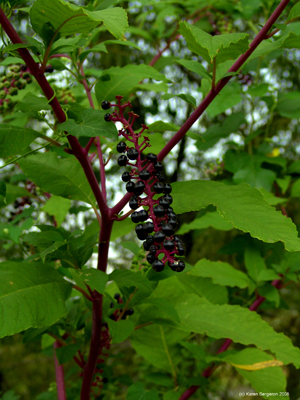
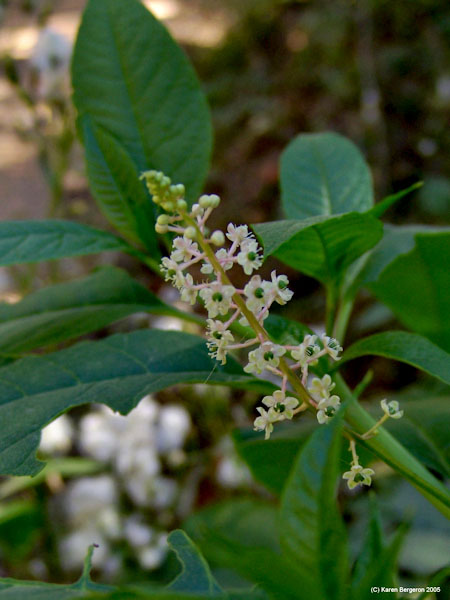
The stout erect stalk is tall, growing to 10 feet or more, smooth and branching, turning deep red or purple as the berries ripen and the plant matures. Poke root is conical, large and fleshy, covered with a thin brown bark. Leaves are about 5 inches long and 2 to 3 inches wide, simple, alternate, ovate-lanceolate, and smooth. The flowers which appear from July to September are long-stalked clusters and each has 5 whitish petals with green centers. The fruit is a rich deep purple round berry, containing a rich crimson juice.
Cultivation: Pokeweed is an easily grown plant, succeeding in most soils and full sun or partial shade.
Gather young edible shoots in spring for Poke Salet. Dig the roots in fall, slice and dry for later use, and lay berries on a flat surface to dry when they ripen.
Pokeweed History and Folklore
Some Native American tribes used Pokeweed as a Witchcraft Medicine, believing that its ability to totally purge the body by causing drastic diarrhea and vomiting would also expel bad spirits. Fruit was made into a red dye used in painting horses and various articles of adornment.
Links to more information about Pokeweed
Mucosal Toxicity Studies of a Gel Formulation of Native Pokeweed Antiviral Protein
POKEWEED ANTIVIRAL PROTEIN POLYPEPTIDES WITH ANTIVIRAL ACTIVITY
Wildcrafting: Pokeweed is toxic, except for brief time in spring
Disclaimer
The herbal information on this web site is intended for educational purposes only. It is not the intention of the editor to advise on health care. Please see a medical professional about any health concerns you have. These statements have not been evaluated by the FDA. The information on this web site is not intended to prevent, diagnose, treat, or cure any disease.