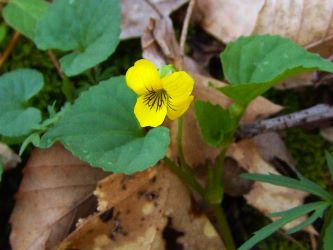
Violet
Viola odorata
Other Names: Ordinary violet, Common blue
violet, Sweet violet, Garden violet
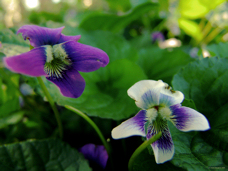
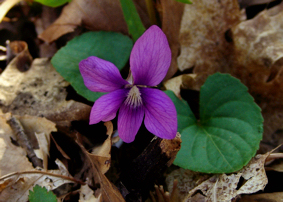
(Various wild violets pictured)
Violet Herbal Use
An edible herb, the flowers and leaves of Violet are made into a syrup used as an herbal remedy for respiratory ailments associated with congestion, coughing, and sore throat.
Violet Syrup
Pour 1 pint of boiling water over 1 cup packed, of fresh crushed flowers and leaves cover and let stand for 12 hours. Strain and squeeze through cloth, add 2 lb. of sugar and boil for 1 hour or until syrupy. Store in glass jar. Give 1 tbs. (1 tsp. for children) 2 or 3 times a day.
Violet Tea
Steep 1 cup dried or fresh herb in 1 cup of water for 10 min. stain, flavor to taste. Take in 1/2 cup doses twice a day.
Violet flowers and leaves are edible and used as food additives for instance in salad, made into jelly, and candied for decoration.
Large doses of Violet root contain an alkaloid called violine which is emetic (causing vomiting).
A decoction made from Violet root (dry herb) is used as a laxative. Tea made from the entire Violet plant is used to treat digestive disorders and new research has detected the presence of a glycoside of salicylic acid (natural aspirin) which substantiates its use for centuries as a herbal remedy for headache, body pains and as a sedative.
Violet plant constituents are being studied and show these uses to be valid. Eugenol, Ferulic-acid, Kaempferol, Quercetin, Scopoletin, also show promise in the treatment of many kinds of cancer, arthritis, AIDS, gum disease and more.
Violets are also used externally. The fresh crushed leaves reduce swelling and soothe irritations. As a bath additive the fresh crushed flowers are soothing to the skin and the aroma is very relaxing.
Violet Folklore
The Ancient Greeks considered the Violet a symbol of fertility and love, they used it in love potions. Pliny recommended that a garland of them be worn about the head to ward off headaches and dizzy spells.
Violet Description and Habitat
The heart shaped leaves of Viola Ordorata are often with scalloped or slightly serrated edge. They are dark green, smooth or sometimes downy underneath, and grow in a rosette at the base of the plant. The roots are creeping and send out runners. Depending on soil and light, the flowers may be from deep purple or blue to pinkish or even yellow whitish. All have 5 petals, which may have a yellow (fur) or beard on the inside of two of the petals, blooming from March to June. Gather flowers in full bloom, leaves anytime, and rootstock in fall. Dry root for later use.
Violets are European perennials. They are now naturalized throughout North America, and can be found growing in most any soil or situation. They often take over in lawns.
Violets are easily cultivated through root cuttings or seeds. With over 900 species, plant identification to the exact is an expertise in itself. However all have practically the same herb values as edibles and in herbalism.
Article by Deb Jackson & Karen Bergeron, Violet Herb Photos by Karen Bergeron Copyright 2000
Disclaimer
The herbal information on this web site is intended for educational purposes only. It is not the intention of the editor to advise on health care. Please see a medical professional about any health concerns you have. These statements have not been evaluated by the FDA. The information on this web site is not intended to prevent, diagnose, treat, or cure any disease.