Wild Yam
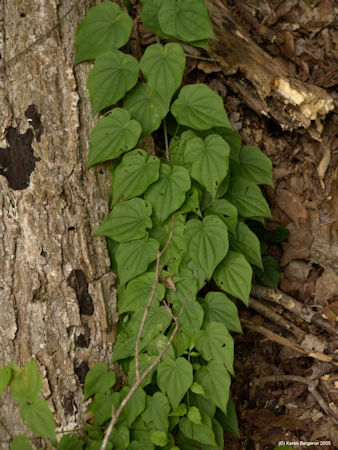
Other Names: Colic-root, Devil's-bones, Rheumatism Root, Wilde Yamwurzel
Dioscorea Villosa
Wild Yam Herbal Use
Wild Yam root was used for centuries as a herbal remedy by the Aztec and Myan peoples for a wide range of ailments including many female problems and to relieve the pain of childbirth.
Wild Yam root is edible and has been used as an herbal remedy. Though it is said to be bland, when seasoned, it can be tasty.
Wild Yam may be useful in alternative medicine as it contains many steroidal saponins, mainly Dioscin. Dioscin is widely used to manufacture progesterone and other steroid drugs used as contraceptives and in the treatment of various disorders of the genital organs as well as in other diseases such as asthma and arthritis.
A decoction of the root is used to alleviate many of the symptoms of menopause and PMS such as hot flashes, night sweats, mood changes, and vaginal dryness. It is also used to treat irritable bowel syndrome, gastritis, gall bladder complaints, spasmodic cramps, painful menstruation, and in small doses may help treat the nausea of pregnant women.
Please consult a physician before using herbal remedies during pregnancy and breast-feeding.
Other constituents including Phytosterols (beta-sitosterol), alkaloids and Tannins, make this plant potentially useful as an anti-inflammatory, antispasmodic, cholagogue, diaphoretic and vasodilator.
Animal and human studies suggest that Dioscorea villosa (Wild yam),and Broccoli may protect against osteoporosis and breast and gynecological cancers but further evidence is required.
Herbal preparations for the menopause: beyond isoflavones and black cohosh.
Wild Yam Habitat and Description
Wild Yam is a perennial native to Eastern N. America from New England to Minnesota and Ontario, south to Florida and Texas. It is most common in the central and southern United States. Wild Yam is found growing in damp woods and swamps, thickets, roadside fences, and hedges. The Wild Yam plant is a trailing vine that climbs over adjacent shrubs and bushes. It can be found growing to a length of 15 feet or more. It has a smooth, reddish-brown stem and heart-shaped long-petioled leaves from 2 to 6 inches long and 1 to 4 inches wide. Wild Yam leaves have very prominent veins which run lengthwise from the center top of the heart shape out into a fan pattern. They are usually alternate but sometimes grow in twos and fours near the base of the plant. Wild Yam root runs horizontally beneath the surface of the ground. It is long, branched, crooked, and woody, forming tubers which are light brown outside and white fibrous inside. The small, greenish-yellow flowers are produced in drooping clusters about 3 to 6 inches long (male) and in drooping, spike-like heads (female), blooming from June to August.
How to Grow Wild Yam
Wild Yam cultivation is easy from root cuttings taken in the winter or late fall. Tubercles or baby tubers can be found in the leaf axils in late summer and early autumn. These should be taken when about pea size and easily fall away from the vine. They should be planted immediately in individual pots and kept inside till spring. Wild yam prefers sandy to loamy medium, well-drained, moist soils and requires partial shade.
Although common in the woodlands in my part of Middle Tennessee, Wild Yam is listed as endangered by United Plant Savers and they say it should never be harvested from natural habitat.
Wild yam rootlets planted in pots immediately after harvesting from destroyed forest habitat will die back within a dew days. However if kept in gallon pots with potting soil in shade and watered every other day, they will spring back up after about three weeks.
Harvesting Wild Yam
Gather tubers and roots in fall, dry for later herb use. Not to be stored for longer than one year.
Wild Yam Recipe
Decoction: Place 8 oz. chopped Wild Yam root in nonmetallic sauce pan, cover with water and bring to boil then reduce heat simmer for 20 to 30 min. Strain and store in refrigerator. Take in 1/2 cup doses twice a day.
Wild Yam Links
Article by Deb Jackson & Karen Bergeron (c) 2000 Updated 08/02/2019
Disclaimer
The herbal information on this web site is intended for educational purposes only. It is not the intention of the editor to advise on health care. Please see a medical professional about any health concerns you have. These statements have not been evaluated by the FDA. The information on this web site is not intended to prevent, diagnose, treat, or cure any disease.