Bee Balm, Wild Bergamot,
Herb Uses
Other Names: Eastern Bee balm, Bergamot, Wild Oswego Tea, Horse mint, Monarda
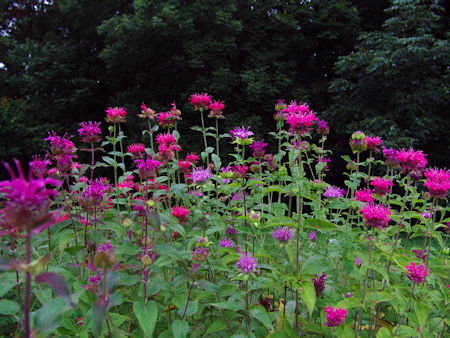
(purple); Monarda fistulosa,
(pink). (c) Altnature 2016
Bee Balm herb is edible and has traditional uses as a medicinal plant. All above ground parts of the plant are edible and used as a pot herb, and also used as a flavoring in cooked foods. The flowers make an attractive edible garnish in salads.
Bee Balm herb is noted for its fragrance, and is a source of oil of thyme. The fresh or dried leaves are brewed into a refreshing, aromatic herbal tea.
Bee Balm leaves and flowers and stems are used by herbalists as an antiseptic, carminative, diaphoretic, diuretic and stimulant. An herbal infusion is used internally in the treatment of colds, catarrh, headaches, and gastric disorders, to reduce low fevers and soothe sore throat, to relieve flatulence, nausea, for menstrual pain, and insomnia.
Steam inhalation of the plant can be used for sore throats, and bronchial catarrh (inflammation of the mucus membrane, causing an increased flow of mucus). Externally, Bee Balm is used as an application for skin eruptions and infections.
Abstract: Monarda fistulosa essential oil characterized by pronounced therapeutic effects is proposed for the treatment of seborrhea. Studies of its antibacterial, anti-mycotic, and anti-inflammatory activities showed that it inhibits microorganism growth and is superior to hydrocortisone in combination with vitamin B6 by its anti-inflammatory activity. PMID: 20396753 [Indexed for MEDLINE]
Bull Exp Biol Med. 2009 Oct;148(4):612-4.
Study of Monarda fistulosa essential oil as a prospective antiseborrheic agent. Zhilyakova ET1, Novikov OO, Naumenko EN, Krichkovskaya LV, Kiseleva TS, Timoshenko EY, Novikova MY, Litvinov SA.
Author information 1 Belgorod State University, Russia.
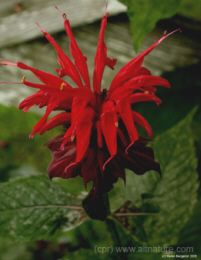
Red Bee Balm, Monarda didyma, is also known as Oswego Tea
Bergamot’s distinctive aroma, found in both the leaf and flower is wonderful for use in potpourri. While a fragrant herb in its own right, Wild Bergamot is not the source of the commonly used Bergamot Essential oil.
Habitat and Description
Bee Balm is a perennial herb native to Eastern North America. It grows in dry thickets, clearings and woodland edges from Ontario and British Columbia to Georgia and Mexico.
Bee Balm has showy, red, pink, or lilac flowers in large heads or whorls of about 20-50 flowers at the top of the branching stem, supported by leafy bracts, the leaflets are a pale-green color. The stem of Bee Balm is square, grooved and hard; and about 3 feet high. The leaves occur in opposite pairs, are rough on both surfaces, are distinctly toothed, and lance-shaped. Fine dense hairs cover much of the stem and leaves. Bee Balm roots are short, slender, creeping rhizomes.
How to Grow Bee Balm
Bee Balm is easily grown in ordinary garden soil. It also grows well in heavy clay soils.
Bee Balm requires a part shade to sunny place to grow. This species thrives when grown in a dry soil and prefers alkaline soil conditions.
Bee Balm is best started from plants which spread like crazy, but will grow from seed as well. Unfortunately, it often gets spotted with a mold like affliction at bloom time when cultivated. The wild plants seem to be less affected.
(Bee Balm Photos by Karen Bergeron Copyright 2006- 2021. Permission required to use herb pictures from this site. ) Licensing
How to Harvest and Use Bee Balm
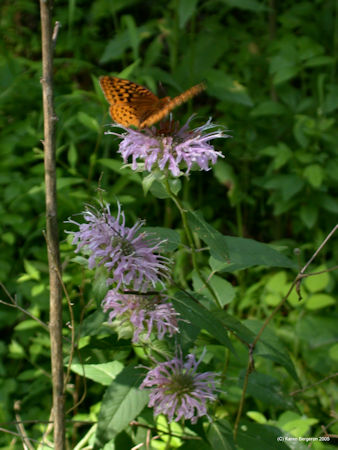
Wild Bergamot flowers bloom from June to July. Gather edible leaves and flowers in bloom, dry on small bundles in paper bags in a dry, well ventilated area. Bee Balm can be used as tea, or as an aromatic suitable for sachets and potpourri.
Herbal Tea Recipe
"Medicinal" tea: To 1 tsp. dried herb, add 1 cup boiling water, steep 10 min. sweeten to taste, take at bedtime.
Folklore and History
The red variety of Bee Balm is commonly known as Oswego Tea. It was used by colonists in place of English Tea after the Boston Tea Party, when they threw the English tea in the harbor to protest the high taxes imposed on it by the British.
Bee Balm was used as a healing plant by Native Americans who recognized four varieties that had different odors. Wild Bergamot was used also as an active diaphoretic (sweat inducer) for ceremonial sweat lodges. A decoction of the herb was made into hair pomade.
Bee Balm Links
Article by Deb Jackson & Karen Bergeron Copyright 1999 - 2020
Disclaimer
The herbal information on this web site is intended for educational purposes only. It is not the intention of the editor to advise on health care. Please see a medical professional about any health concerns you have. These statements have not been evaluated by the FDA. The information on this web site is not intended to prevent, diagnose, treat, or cure any disease.