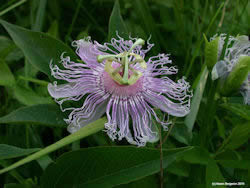
Passionflower Herb Uses
Passiflora incarnata
Other Names: Passion
Flower, Maypop, Apricot vine, Passiflore rouge,
Passionsblume, Purple Passion-flower, Passion
Vine
Page 1 Passionflower Herb Uses ~ Safety Information ~ Passionflower
Description/Habitat ~ How to Grow Passionflower
Page 2 Passionflower Folklore and
History ~ Harvesting Passionflower ~ Helpful Books and Web
Sites ~ Links to Clinical Studies
There are over 400 species of Passionflower growing throughout the world. This article is about Passionflower incarnata which is native to the Midwestern and Southeastern United States, and is the species most commonly used in Alternative Medicine. Passionflower is the official wildflower of Tennessee.
Properties attributed to Passionflower
Inconclusive - anodyne, antispasmodic, anxiolytic, aphrodisiac, aromatic, narcotic, sedative.
Passionflower herb is used in
alternative medicine for anxiety, insomnia,
nervous disorders and seizures. It is more
commonly used in Europe than its native home,
the United States, where it can be found
growing profusely in fields and on fencerows.
Passionflower has been approved by Germany’s
Commission E for the treatment of “nervous
unrest". It is now exported to and grown
in many European countries.
Passionflower is said to be useful for
back pain due to action on the nerves.
Passionflower’s calming properties may
also be helpful for ADD and ADHD. However,
since it has not been extensively studied, it
is not advisable to use on children without
approval of their doctor. See Links to Clinical Studies on
Passionflower to learn more.
Passionflower is not considered as strong in
action as Valerian or Kava, but might be a
good option for those who can’t stand
the taste of the stronger herbs. It also has
a reputation as an aphrodisiac. I’ve
heard stories...... you’ll have to
find out for yourself. I can see where the
calming effects would be helpful in that
department.
Passionflower is both an edible and medicinal plant. As a tea, It is often blended with Valerian, Chamomile, Lemon Balm, Skullcap, St. John’s Wort or other relaxing herbs. On its own in tea, it has a pleasant, very mild but unusual taste, much like its fragrance, that is hard to describe. The color of the infusion is a very pale green, lighter in color than most herbal teas. Some people say the scent as an aphrodisiac fragrance. One of my readers said he thinks it is like green beans, hmm...... maybe raw sweet peas? I like throwing a handful in my iced tea blends, as it seems to help with concentration when writing. The taste is not at all overwhelming so it could blend well with most any herb or iced tea.
Passionflower Herbal Tea Recipe
To 1 tbsp. dried herb (include stems) add 1 cup boiling water steep for 10 min. drink at bedtime for restlessness and insomnia, or during the day to calm anxiety.
Passionflower Edible Uses
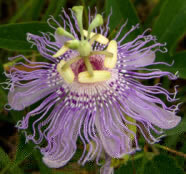
The flowers can add a tasty and decorative touch to salads, or used to make a syrup. The fruit can be eaten raw or made into jams, jellies, or wine. Our native Passion flower fruit is most commonly called Wild Apricot, and is not the tropical Passionflower which yields Purple Passion Fruit. It is smaller than the Purple Passion Fruit but can be used in recipes that call for the tropical variety. The seeds may contain a minute amount of cyanide like properties, and one should not eat them in large amounts - just to be on the safe side.
Passionflower Jam Recipe Passionflower Fruit Wine Recipe
Try dried fragrant Passionflower leaves, fruits, buds and flowers in herbal sachets, baths, and herb pillows, too!
An extract, or tincture, can also be
made. The Simpler’s Method for making
tinctures is to fill a jar with chopped fresh
or ground dried herb and cover with 100 proof
vodka. Shake the jar daily for two weeks, then
strain. I prefer to start it at the new moon
and strain it when the moon is full- just
because things seem to work better for me when
started in a new moon. Store in jar in dark
cabinet and keep some in a dropper bottle for
convenient use. The usual dose is 30-45 drops
up to 3 times a day. For advanced information
on tinctures and other preparations, read Making Plant
Medicine
#Passionflower Safety & Interaction Information
Passionflower is on the FDA’s “generally
recognized as safe” list; however, it might
increase the action of other sedative
medications and herbs. If taking MAO-inhibiting
antidepressant medications, it is best to
consult with a physician before using Passion
Flower. Safety in young children, pregnant or
nursing women, or those with severe liver or
kidney disease has not been established.
Passionflower is considered safe for most
people when used at recommended dosage.
Overdose may cause dizziness and other symptoms
of over sedation. More information can be found
at these pages.
User Reviews & Ratings -
PASSIONFLOWER from WebMD
Passionflower Description and Habitat
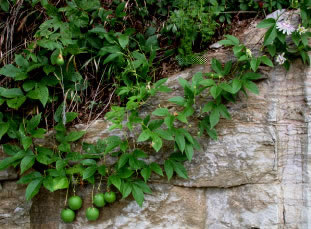
Passionflower is a perennial vine that
grows up to 30 ft. (10m). It grows very quickly
and produces edible fruit. It has deeply
three-lobed leaves with finely serrated
edges and large, aromatic, beautifully
intricate purple and white sweet-scented
flowers that are from 2 to 3 inches across. All
above ground parts of the plant are aromatic,
with a strong sweet fragrance. Passion flowers
bloom from June to September, and possibly
later when it has been cut during the season.
They have tendrils that attach to tall grasses
or whatever they can hold of to climb. The
passion fruit, when ripe is yellow-green and
the size of a small hen’s egg.
Passionflower is found from
Virginia and Kentucky, south to Florida and
Texas. It grows in sandy thickets and open
fields, roadsides, fence rows and waste places.
It has also naturalized out of its native range
and can be found in Southern Illinois and other
parts of the Midwest.
USDA Distribution Map
How to Grow Passionflower
Passionflower is easily cultivated
through root division or by seed, but cuttings
rooted in water or sand are probably the
easiest way to propagate it. It is said that it
requires a well-drained soil, sandy slightly
acid soil in full sun, but it can be found
growing in southern hayfields in soil with a
lot of heavy clay. A trellis should be provided
for maximum growth and display, since it is a
climbing vine with tendrils seeking something
to latch on to.
My experience has been that wild grown
plants do not transplant well to a garden
setting, most likely because Passionflower has
a long tap root that usually breaks when one
attempts to dig it up. Perhaps it is best to
just bury ripened fruit, and cover with a
little dirt to ward off foraging animals and
birds, where you wish them to grow. A fertile
soil, high in nitrogen, will produce large
plants and leaves, but may not have as many
flowers and fruit. In greenhouse cultivation,
various heat treatments are used to increase
germination. Richo Cech explains more about
this in his book The Medicinal Herb Grower,
Volume 1
Page 2 Passionflower Folklore and
History ~ Harvesting Passionflower ~ Helpful Books and Web
Sites ~ Links to Clinical Studies
Disclaimer
The herbal information on this web site is intended for educational purposes only. It is not the intention of the editor to advise on health care. Please see a medical professional about any health concerns you have. These statements have not been evaluated by the FDA. The information on this web site is not intended to prevent, diagnose, treat, or cure any disease.